
What changed, what it means for hiring and why most companies are still catching up.
Pull up an engineering job description from 2021 and compare it to one posted this month. The difference is striking — not because the titles changed, but because the underlying definition of the work did.
The shift wasn't a slow evolution. It compressed into roughly two years, driven by AI coding tools becoming default infrastructure rather than optional experiments. By 2025, around four in five developers were using AI tools daily. The job didn't disappear. It reorganized around a different set of skills — and most hiring processes haven't caught up yet.
What engineering job descriptions actually asked for and what they ask for now.
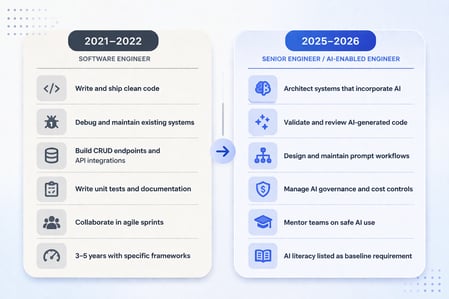
The tasks that used to define junior roles — boilerplate, basic debugging, routine documentation — are now handled largely by tools like GitHub Copilot, which writes around 40% of code in files where it runs. That didn't make engineering easier. It raised the floor of what's expected from everyone on the team.
New titles that didn't exist on org charts three years ago.
The clearest sign that job descriptions changed isn't the language inside existing postings — it's the roles that simply didn't exist before. Prompt engineers. AI governance leads. MLOps engineers. AI platform engineers whose entire job is managing model costs, guardrails and data leakage prevention across the stack.
These aren't research roles. They're operational. Companies reached "AI in production" faster than they built the infrastructure to manage it, and the job market responded by creating titles to fill the gap. Most of these roles sit at the intersection of software engineering, security and developer experience — a combination that didn't have a name two years ago.
The premium followed accordingly. Compensation for AI-adjacent engineering skills climbed sharply while salaries for purely execution-oriented roles flatlined. The market is pricing judgment, not output.
Why a lot of companies are screening for the wrong things.
Here's what we see often: a company updates its job title to include "AI" but keeps the underlying requirements identical to what they were posting in 2022. Long lists of frameworks. Narrow version-specific experience. Timezone requirements driven by habit rather than actual collaboration needs.
They end up filtering out exactly the engineers who would thrive in the current environment — people with strong systems intuition, cross-functional range and the kind of practical resourcefulness that makes them effective even when the tooling is new or imperfect.
The engineers who do well in AI-native teams aren't necessarily the ones with the longest resume. They're the ones who know what to question, when to trust the tool and how to communicate the difference to the people around them. That profile is harder to screen for with a keyword filter — but it's the profile that moves teams forward right now.
At SouthGeeks, we work with US tech teams navigating exactly this shift — figuring out what the role actually needs to be before writing the description. If your hiring process feels like it's producing mismatches, that's usually where the gap is.

Latin America Is Where the World's AI Infrastructure Is Being Built

Agents and Us